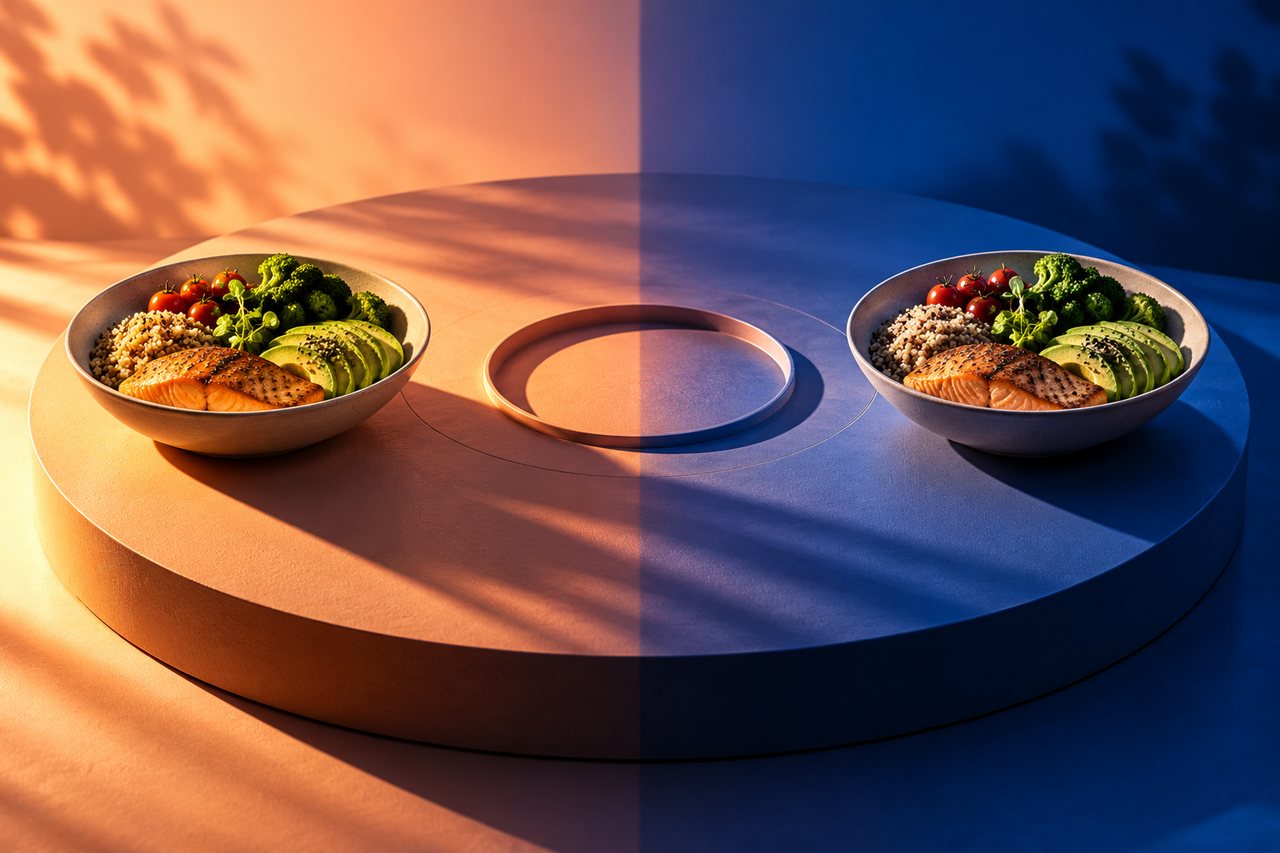
"Eat after 7 pm and it all turns to fat." You've probably heard some version of this, maybe from a grandparent, maybe from a wellness video. It's an appealing idea. Your body runs on a 24-hour clock, so surely the same meal lands differently at 8 am and at 9 pm?
It's a fair question, and researchers have started testing it properly. The answer is more interesting than yes or no.
What the evidence shows
When the amount stays the same. The cleanest test comes from Germany. Thirty-one women with overweight or obesity tried two eating windows, two weeks each, in random order: an early one from 8 am to 4 pm, and a late one from 1 pm to 9 pm (Peters et al., Science Translational Medicine, 2025). They were asked to eat their usual food in their usual amounts — only the clock changed.
Their body clocks noticed. On the late schedule, the internal clock in their blood cells and the midpoint of their sleep both shifted later, sleep by about 15 minutes. But their metabolism didn't follow. Insulin sensitivity — how well the body responds to insulin — didn't change, and neither did blood sugar, blood fats or markers of inflammation.
One small detail is telling. On the early window, the women ate about 167 fewer calories a day without trying to, and lost a little more weight: about 1.1 kg against 0.4 kg. Timing and quantity are hard to pull apart, even in a careful study.
When people simply choose a window. A Spanish trial gave 197 adults with overweight or obesity education about the Mediterranean diet, with or without an eight-hour eating window — early, late, or their own choice (Dote-Montero et al., Nature Medicine, 2025). After 12 weeks, MRI scans showed no difference in visceral fat, the deep belly fat linked to heart and metabolic disease. Early, late or self-chosen, adding a window did no better than the diet advice alone.
A Johns Hopkins trial that fed 41 people identical calories found the same thing: eating most of the day's food before 1 pm, rather than mostly in the evening, didn't change weight or blood sugar over 12 weeks (Maruthur et al., Annals of Internal Medicine, 2024). We look at that one in Intermittent fasting works — but not for the reason you think.
When you pool lots of trials. Here the picture tilts. A 2026 analysis of 41 trials with 2,287 people found that eating early — last meal before 5 pm — beat eating late by about 1.2 kg, with lower insulin levels too, and the authors rated that evidence highly (Chen et al., BMJ Medicine, 2026). Its literature search ended in early 2023, so it doesn't include the two newer trials above.
And in a trial of 209 adults at risk of type 2 diabetes, fast days built around early eating improved blood sugar after meals more than ordinary dieting at six months — but the advantage was gone by 18 months (Teong et al., Nature Medicine, 2023). More on that in Why fasting results fade: the 18-month problem.
Why scientists still disagree
The two sides are mostly measuring different things. Studies that hold food steady find little or no effect of timing. Studies that let people eat freely often find a small advantage for eating early — but people who eat early may also eat a bit less, as the German trial showed.
The studies are also short — two to twelve weeks for the controlled ones — and small. And pooled analyses rank schedules partly through indirect comparisons, which is useful for spotting a signal but weaker than a direct test.
What you'll hear online
"Eating late makes you gain weight." When the amount of food was held steady, late eating didn't cause extra weight gain or worse blood sugar in the trials above. Late eating may make it easier to eat more — that's a different claim.
"Your body clock decides everything." Your clock does respond to meal timing; the German study measured it. Whether that shift matters for your long-term health is still unknown.
Before believing any fasting claim, it helps to ask five quick questions:
Five questions before you believe a fasting claim
- Was this seen in people, or in mice?
- How many people, and for how long?
- Compared to what? (Same amount of food, or not?)
- Did they measure a real outcome, or a number in the blood?
- Does the person telling me this sell something related? (Not an accusation — just useful to know.)
What would actually settle it
A trial lasting a year or more, with the amount of food carefully matched, comparing early and late eating in a wide range of people — including people whose working hours don't fit a 9-to-5 day — and tracking real outcomes, not just blood tests. It's a genuinely open question, and well worth funding.
What you can do
If your evenings tend to run late, try moving your last meal a little earlier for a couple of weeks and notice how you feel and sleep. If your life doesn't allow it — shifts, children, a late commute — don't worry: for weight and blood sugar, what and how much you eat seem to matter far more than the clock. A gentle version of the idea is in The easiest fast: stop eating three hours before bed.
If you take medication for diabetes, talk to your doctor before changing your meal times. Your doctor will know what applies to you.
Timing is real biology. It's just not the boss.
Curiosity first.
— Dr. Brugal
Voices in the debate
If you'd like to hear the case for meal timing from doctors who champion it, these are some of the most influential voices. Their views often go beyond what published human trials have shown so far — which is exactly why it's worth hearing them and checking the studies side by side.
- Dr Rangan Chatterjee — MD, family doctor in the UK and podcast host, who highlights when we eat and suggests a daily eating window of 10 to 12 hours for energy, sleep and digestion. Feel Better, Live More, episode #306
- Prof Andreas Michalsen — MD PhD, Charité Berlin, internal and nutritional medicine, who champions therapeutic fasting alongside healthy eating. He is also one of the co-authors of the German timing study above. Book: The Fasting Fix. Penguin Random House
- Dr Steven Gundry — MD, former cardiac surgeon, who favours a six-to-eight-hour eating window for longevity and cell health. NBC California Live
For the wider debate, see our series guide: Why scientists still can't agree on fasting.
References
All studies retrieved via PubMed.
- Peters B, Schwarz J, Schuppelius B, et al. Intended isocaloric time-restricted eating shifts circadian clocks but does not improve cardiometabolic health in women with overweight. Science Translational Medicine. 2025;17(822):eadv6787. Randomised crossover trial, 31 women, two weeks per schedule. doi:10.1126/scitranslmed.adv6787 (PMID 41160666)
- Dote-Montero M, Clavero-Jimeno A, Merchán-Ramírez E, et al. Effects of early, late and self-selected time-restricted eating on visceral adipose tissue and cardiometabolic health in participants with overweight or obesity: a randomized controlled trial. Nature Medicine. 2025;31(2):524-533. Randomised trial, 197 adults, 12 weeks. doi:10.1038/s41591-024-03375-y (PMID 39775037)
- Maruthur NM, Pilla SJ, White K, et al. Effect of isocaloric, time-restricted eating on body weight in adults with obesity: a randomized controlled trial. Annals of Internal Medicine. 2024;177(5):549-558. Randomised controlled feeding trial, 41 adults, 12 weeks. doi:10.7326/M23-3132 (PMID 38639542)
- Chen YE, Tsai HL, Tu YK, et al. Effects of timing and eating duration of time restricted eating on metabolic outcomes: systematic review and network meta-analysis. BMJ Medicine. 2026;5(1):e001071. Network meta-analysis of 41 randomised trials, 2,287 people. doi:10.1136/bmjmed-2024-001071 (PMID 41586347)
- Teong XT, Liu K, Vincent AD, et al. Intermittent fasting plus early time-restricted eating versus calorie restriction and standard care in adults at risk of type 2 diabetes: a randomized controlled trial. Nature Medicine. 2023;29(4):963-972. Randomised trial, 209 adults, 6 months plus 12-month follow-up. doi:10.1038/s41591-023-02287-7 (PMID 37024596)
Awareness content — not medical advice. Always talk to your doctor or pharmacist before making changes.