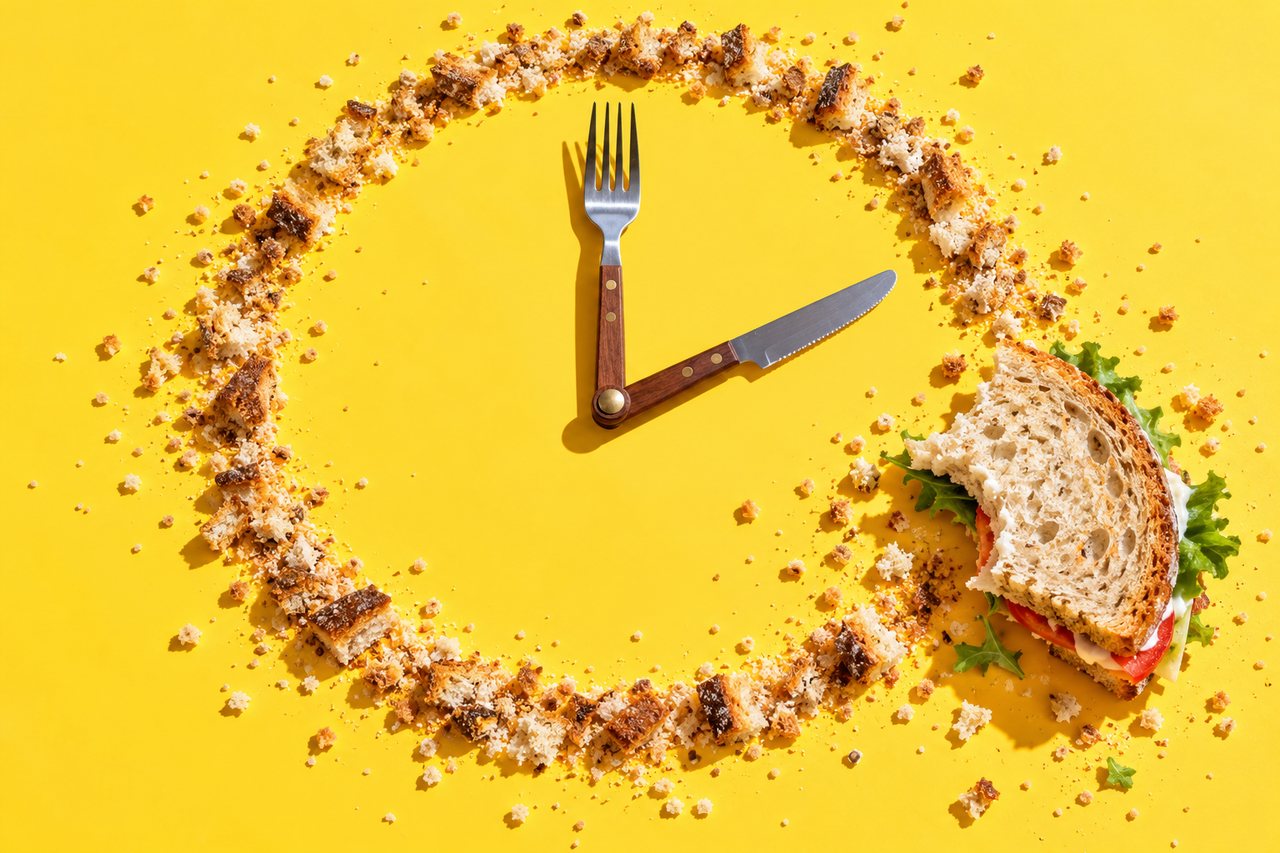
Skip breakfast, eat between noon and eight, and your body flips into fat-burning mode. That's the pitch for 16:8 you've probably heard. It's simple, it needs no app, and plenty of people swear by it.
Here's the twist. When scientists put intermittent fasting up against an ordinary calorie-cutting diet, the two came out almost level. Fasting works. It just doesn't seem to work for the reason most people think.
What the evidence shows
The most careful summary so far is a Cochrane review published in February 2026. Cochrane reviews gather every good-quality trial on a question and grade how sure we can be of the answer. This one pooled 22 randomised trials involving 1,995 adults living with overweight or obesity (Garegnani et al., Cochrane Database of Systematic Reviews, 2026).
Compared with standard dietary advice, intermittent fasting made little or no difference to weight loss — about a third of a percentage point, well within the noise. Quality of life and side effects were similar too. The authors rated their certainty as low, and every trial lasted 12 months or less.
A second, even larger analysis in the BMJ looked at 99 randomised trials covering 6,582 adults (Semnani-Azad et al., BMJ, 2025). Every approach — eating windows, whole fasting days, alternate days and plain daily calorie cutting — beat eating freely. Against each other, the differences were small, and the authors concluded that fasting has broadly similar benefits to a normal calorie-reduced diet.
So why does it work at all? The clearest clue comes from a trial at Johns Hopkins that did something most diet studies can't: it provided every meal (Maruthur et al., Annals of Internal Medicine, 2024). Forty-one adults with obesity and prediabetes or diet-controlled diabetes ate the same food and the same calories for 12 weeks. Half ate within a 10-hour window, with 80% of their calories before 1 pm. The other half ate on a typical pattern, with at least half their food after 5 pm.
Both groups lost a similar amount of weight: 2.3 kg with the early window, 2.6 kg on the usual pattern. Blood sugar measures didn't differ either. The authors' reading: the weight loss seen in earlier fasting studies probably came from people eating less.
That's the real story. Intermittent fasting is a tool for eating less — and for some people, a very good one.
Why scientists still disagree
If the big reviews look so tidy, why is there still a debate? Three reasons.
The trials are short. Every study in the Cochrane review lasted a year or less, and the BMJ team asked for longer ones. Weight is a long game; a year is the warm-up.
"It's only calories" isn't proven either. The Johns Hopkins trial was small — 41 people, mostly Black women with an average age of 59, at a single site — and the two groups didn't start at the same weight. Small studies can miss small effects. And some trials do hint that timing matters a little, especially for blood sugar. Those signals are modest and uncertain; we look at them in Does it matter when you eat? Early vs late eating windows (coming soon).
Mice keep the clock idea alive. The Johns Hopkins team ran their trial partly because, in rodents, eating windows appear to cause weight loss without cutting calories. Mice aren't people, but those results are where the "it's the clock" story comes from.
What you'll hear online
"It's not about calories, it's about insulin." This is one of the most popular claims, and it comes from respected doctors. In the trial above that held calories steady, the eating window didn't change weight or blood sugar. One small study doesn't close the question — but it's exactly the test the claim needs to pass, and so far it hasn't.
"16:8 burns more fat than dieting." Against a normal diet with a similar calorie cut, the large reviews found no meaningful difference in weight.
Before believing any fasting claim, it helps to ask five quick questions:
Five questions before you believe a fasting claim
- Was this seen in people, or in mice?
- How many people, and for how long?
- Compared to what?
- Did they measure a real outcome, or a number in the blood?
- Does the person telling me this sell something related? (Not an accusation — just useful to know.)
For intermittent fasting, question three does most of the work. Against eating freely, fasting wins. Against eating less in the ordinary way, it's roughly a draw.
What would actually settle it
A trial lasting two or three years, with enough people, that carefully matches calories between a fasting group and a normal-diet group, and tracks real outcomes like developing diabetes — not just the number on the scale. The Cochrane authors made the same call: follow people for longer than 12 months. It's expensive and unglamorous, and it's exactly the kind of study worth funding.
What you can do
Treat fasting as one way of eating less, not as a separate kind of magic. If a shorter eating window makes it easier for you to eat less without feeling miserable, that's a perfectly good reason to use it. If it leaves you ravenous by 8 pm, an ordinary calorie-reduced diet seems to do about as well.
If you take medication for diabetes or blood pressure, talk to your doctor before you change when you eat — we cover the questions to ask in Before you fast on medication: the questions to ask your doctor (coming soon).
The best eating plan is the one you can actually live with. Fasting is allowed to be that plan. It just isn't a shortcut.
Curiosity first.
— Dr. Brugal
Voices in the debate
If you'd like to hear the case for fasting from doctors who champion it, these are some of the most influential voices. Their views often go beyond what published human trials have shown so far — which is exactly why it's worth hearing them and checking the studies side by side.
- Dr Jason Fung — MD, nephrologist (Canada), who argues that fasting is a central tool against obesity and type 2 diabetes and that insulin plays a key role. Books: The Obesity Code, The Complete Guide to Fasting.
- Dr Michael Mosley (1957–2024) — trained in medicine at the Royal Free Hospital and became a BBC science journalist; he popularised the 5:2 diet and argued for possible benefits beyond weight. Book: The Fast Diet; BBC documentary Eat, Fast and Live Longer (2012). Obituary
For the wider debate, see our series guide: Why scientists still can't agree on fasting (coming soon).
References
All studies retrieved via PubMed.
- Garegnani LI, Oltra G, Ivaldi D, et al. Intermittent fasting for adults with overweight or obesity. Cochrane Database of Systematic Reviews. 2026;2(2):CD015610. Systematic review of 22 randomised trials, 1,995 adults. doi:10.1002/14651858.CD015610.pub2 (PMID 41692034)
- Semnani-Azad Z, Khan TA, Chiavaroli L, et al. Intermittent fasting strategies and their effects on body weight and other cardiometabolic risk factors: systematic review and network meta-analysis of randomised clinical trials. BMJ. 2025;389:e082007. Network meta-analysis of 99 randomised trials, 6,582 adults. doi:10.1136/bmj-2024-082007 (PMID 40533200)
- Maruthur NM, Pilla SJ, White K, et al. Effect of isocaloric, time-restricted eating on body weight in adults with obesity: a randomized controlled trial. Annals of Internal Medicine. 2024;177(5):549-558. Randomised controlled feeding trial, 41 adults, 12 weeks. doi:10.7326/M23-3132 (PMID 38639542)
Awareness content — not medical advice. Always talk to your doctor or pharmacist before making changes.