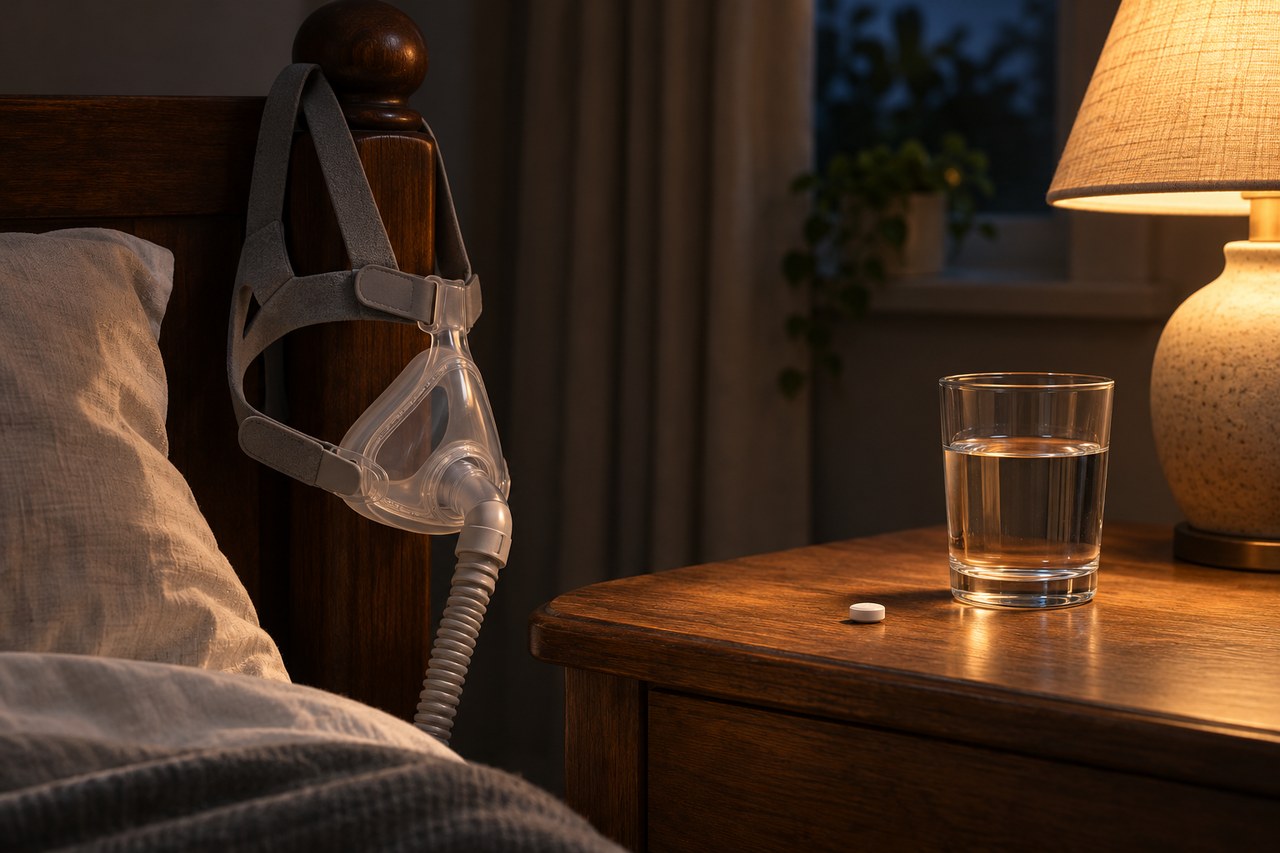
If you've been handed a CPAP machine, you know the bargain: it works, and a lot of people can't bear to wear it. Earlier this year I mapped the four routes out of sleep apnoea. Since then, two sets of trials have tackled the question everyone with a mask on the bedside table is really asking: could I just take something instead?
The two answers are very different — and both are worth knowing.
What the evidence shows
A quick reminder. In obstructive sleep apnoea the upper airway narrows or closes over and over during sleep. Doctors count how often breathing stops or becomes shallow each hour — the apnoea-hypopnoea index, or AHI. Fifteen or more an hour counts as moderate to severe.
The tablet. Sultiame is a carbonic anhydrase inhibitor — a drug that, among other things, nudges the body's breathing drive and the activity of the muscles that hold the airway open. In a phase 2 trial across 28 centres in five European countries, 298 adults aged 18 to 75 with untreated moderate-to-severe apnoea (an AHI between 15 and 50) were randomised to a bedtime tablet of placebo or sultiame at 100, 200 or 300 mg for 15 weeks (Randerath et al., The Lancet, 2025).
The results climbed with the dose. Compared with placebo, the AHI fell by about 16% on the lowest dose, 30% on the middle and 35% on the highest. The authors also report dose-dependent improvements in night-time oxygen levels, sleep quality and daytime sleepiness. So did the side effects: 61% of the placebo group reported at least one adverse event, against 73%, 84% and 91% on the three doses. The signature complaint was paraesthesia — tingling or pins and needles — in 9% on placebo, then 22%, 43% and 57%. Headache was more common on the two higher doses too. The trial was funded by Desitin Arzneimittel, the company developing the drug.
Keep the words "phase 2" in mind. This was a dose-finding study: its job was to ask which dose, if any, deserves the larger trials that approval requires. It was not designed to show whether the drug protects against the heart and blood pressure problems apnoea is linked with.
The injection. Tirzepatide — sold as Mounjaro — is the diabetes and weight-loss medicine, and a 2024 pair of trials tested it in people who had both moderate-to-severe apnoea and obesity (Malhotra et al., New England Journal of Medicine, 2024). At the start, participants were having around 50 breathing events an hour, with an average BMI near 39. One trial enrolled people not using CPAP, the other people already on it. After a year on the highest tolerated dose, the AHI had fallen by about 25 events an hour in the first trial and 29 in the second, against roughly 5 in each placebo group. Weight, overnight oxygen dips, a blood marker of inflammation and systolic blood pressure all improved too. Side effects were mostly gut-related and mild to moderate. Eli Lilly, which makes tirzepatide, funded the trials.
Then came the interesting follow-up. In 2026 the same team asked: were those heart-risk improvements simply the weight loss talking, or did fixing the breathing matter in itself? Using a statistical approach called mediation analysis, they found that improvements in the apnoea measures had their own, independent effect on the inflammation marker, on insulin resistance and on triglycerides. Blood pressure, by contrast, tracked weight. Their conclusion: for people with moderate-to-severe apnoea and obesity, you probably have to treat both the breathing and the weight to get the full benefit for the heart and metabolism (Malhotra et al., Nature Medicine, 2026).
What's still uncertain
Sultiame is early. Fifteen weeks, 298 people, three-quarters of them men, and an outcome — the AHI — that is a number from a sleep study rather than something you feel. We don't know how it compares with CPAP, whether the tingling settles or drives people to stop, or what happens over years.
Tirzepatide was tested in obesity. If your apnoea comes mainly from the shape of your jaw and throat rather than your weight, these trials say nothing about you. And a year is a year: what happens to the airway if the medicine is stopped is an open question.
Both are manufacturer-funded. That's normal for drug trials and not a reason to dismiss them — just useful to know when the headlines arrive.
What you'll hear online
"There's a pill for sleep apnoea now." Not yet, not in the sense people mean. One drug is in mid-stage trials and makes more than half of the people on its top dose tingle. The other is a weight-loss injection that helps when weight is part of the problem — and doesn't replace treating the breathing.
When the next "pill for X" headline lands, five quick questions help:
Five questions before you believe a health claim
- In people, or in mice?
- How many people, and for how long?
- Compared to what?
- Did they measure a real outcome, or a number in the blood — or on a sleep study?
- Does the person telling me this sell something related? (Not an accusation — just useful to know.)
For sultiame, questions two and four do most of the work.
What you can do
If you've quietly stopped using your CPAP, don't let that be the end of the conversation. Book an appointment and ask your doctor whether weight is part of your apnoea story — and if it is, whether treating it belongs in your plan alongside, not instead of, the breathing. Never stop or swap a treatment on the strength of a headline.
The mask is still the mainstay. But for the first time, the drug side of this story has real randomised data behind it — and I'll keep following it here.
Curiosity first.
— Dr. Brugal
Related on Dr. Brugal
This article is a follow-up to The four routes out of sleep apnea — and only one of them is a CPAP. Also worth reading:
References
All studies retrieved via PubMed.
- Randerath W, Grote L, Stenlöf K, et al. Sultiame once per day in obstructive sleep apnoea (FLOW): a multicentre, randomised, double-blind, placebo-controlled, dose-finding, phase 2 trial. The Lancet. 2025;406(10514):1983-1992. Randomised placebo-controlled phase 2 trial, 298 people with moderate-to-severe sleep apnoea, 15 weeks. doi:10.1016/S0140-6736(25)01196-1 (PMID 41077049)
- Malhotra A, Grunstein RR, Fietze I, et al. Tirzepatide for the Treatment of Obstructive Sleep Apnea and Obesity. New England Journal of Medicine. 2024;391(13):1193-1205. Two randomised placebo-controlled phase 3 trials in adults with moderate-to-severe sleep apnoea and obesity, 52 weeks. doi:10.1056/NEJMoa2404881 (PMID 38912654)
- Malhotra A, Grunstein R, Azarbarzin A, et al. Tirzepatide on obstructive sleep apnea-related cardiometabolic risk: secondary outcomes of the SURMOUNT-OSA randomized trial. Nature Medicine. 2026;32(2):653-659. Prespecified secondary and mediation analysis of the two SURMOUNT-OSA trials in people with sleep apnoea and obesity. doi:10.1038/s41591-025-04071-1 (PMID 41540105)
Awareness content — not medical advice. Always talk to your doctor or pharmacist before making changes.