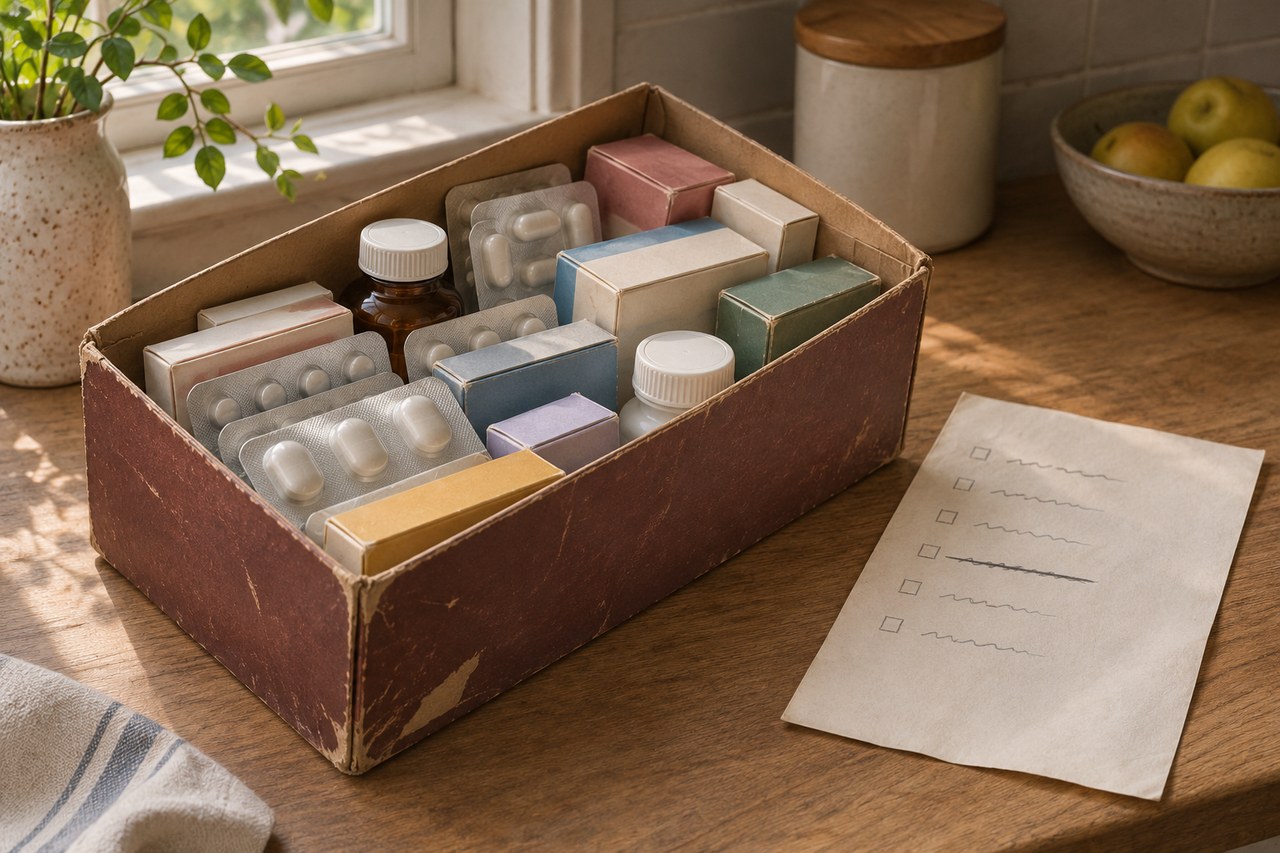
You open the kitchen cupboard at your parent's house and there it is: the shoebox. Twelve boxes, three of them for things nobody can quite explain, one prescribed by a consultant who retired years ago. You wonder: does she need all of these? Could some of them be doing harm? And whose job is it to ask?
There's a name for the deliberate, supervised process of asking those questions: deprescribing. In the last two years several large studies have measured what it actually achieves. The answer is more modest, and more interesting, than either the enthusiasts or the sceptics suggest.
What the evidence shows
It works, a little. A systematic review pooled the best randomised trials of deprescribing in older people living at home, published between 2019 and mid-2024 (Linsky et al., JAMA Network Open, 2025). Across the eight trials that could be combined, people in the deprescribing groups ended up on 0.14 fewer medicines each than controls: a real reduction, but a tiny one per person. The proportion still taking at least one "potentially inappropriate" medicine, a drug on an expert list of ones that often carry more risk than benefit in older people, did not fall significantly. The authors, whose work was US government funded, call the evidence moderate-certainty and point out that a tiny change per person adds up across a population where long medicine lists are the norm.
A larger review cast a wider net (Persaud et al., JAMA Network Open, 2025): 118 randomised trials and 417,412 patients aged 65 or over, living at home or in care homes. Interventions to tackle inappropriate prescribing reduced the number of medicines by roughly half a tablet per person. Then the crucial part: they made no measurable difference to non-serious side effects, injurious falls, quality of life, doctor visits, emergency department attendances, hospital admissions or deaths. The authors' reading is that cutting medicines back appears safe: nothing bad happened when it was done in a structured way. The less comfortable reading is that the benefits we hope for from a shorter list have not yet shown up in the numbers.
How you ask matters. A trial in a large Californian health system (Grant et al., JAMA Internal Medicine, 2025) focused on one high-stakes example: adults aged 75 and over with type 2 diabetes whose blood sugar was already well controlled for their age (HbA1c of 8% or lower), still taking insulin or sulfonylurea tablets, both of which can push sugar too low. The doctors of all 450 patients attended an education session on when to ease off. Half the patients were also handed a leaflet before their appointment inviting them to raise the subject; the other half got a general healthy-lifestyle leaflet. Six months later, 15.8% of the first group had had their diabetes medicines reduced or stopped, against 9.0% of the second; at a year, 22.8% against 16.3%. Severe low-sugar episodes were not significantly different between the groups. A simple handout, given to the patient rather than the doctor, made the conversation markedly more likely to happen.
What doesn't work. A 2024 study tested the cheapest intervention of all (Singh et al., JAMA Internal Medicine, 2024): among 12,787 people with dementia in two large US health plans who were taking antipsychotics, sleeping tablets or strongly anticholinergic drugs, researchers mailed educational materials to the patient and their prescriber, to the prescriber only, or to nobody. Six months later, about 77% in every group were still being dispensed the drug. Letters changed nothing.
What's still uncertain
The reviews pool very different interventions, from pharmacist-led reviews to computer alerts, so "deprescribing works a little" hides a lot of variety. Half a tablet per person is an average; for one individual, stopping the right drug may matter enormously. Most trials ran for months, not the years over which falls and admissions accumulate, and many didn't record harms consistently; the larger review explicitly asks future trials to do so. And the Californian diabetes trial, the most encouraging, is one study in one health system. The honest line is: trimming a long list, done carefully, looks safe and achievable; proof that it prevents the things we fear is still being gathered.
What you can do
Don't trim the list yourself, and don't let your parent either. Instead, do what the diabetes trial did: make the conversation happen. In England, people on ten or more medicines, in care homes or living with frailty are among those who should be offered a structured medication review, usually led by a clinical pharmacist; anyone can ask their doctor or pharmacist for a medication review. Bring the complete list, including anything bought over the counter, and one question: "Which of these is still doing a job, and which one would you stop first if you could?"
The shoebox isn't a failure. It's what happens when good decisions, each sensible at the time, are never revisited. Revisiting them is a job somebody has to ask for. It's often a daughter.
Curiosity first.
— Dr. Brugal
Related on Dr. Brugal
References
All studies retrieved via PubMed.
- Linsky AM, Motala A, Booth M, et al. Deprescribing in community-dwelling older adults: a systematic review and meta-analysis. JAMA Network Open. 2025;8(5):e259375. Systematic review and meta-analysis of 17 randomised trials in older people living at home (8 pooled for the main outcome). doi:10.1001/jamanetworkopen.2025.9375 (PMID 40338546)
- Persaud N, Workentin A, Rizvi A, et al. Interventions to address potentially inappropriate prescribing for older primary care patients: a systematic review and meta-analysis. JAMA Network Open. 2025;8(6):e2517965. Systematic review and meta-analysis of 118 randomised trials, 417,412 people aged 65 and over. doi:10.1001/jamanetworkopen.2025.17965 (PMID 40577011)
- Grant RW, Peterson I, McCloskey JM, et al. Diabetes deprescribing in older adults: a randomized clinical trial. JAMA Internal Medicine. 2025;185(8):926-935. Randomised trial, 450 people aged 75 and over with type 2 diabetes, 12 months. doi:10.1001/jamainternmed.2025.2015 (PMID 40549370)
- Singh S, Li X, Cocoros NM, et al. High-risk medications in persons living with dementia: a randomized clinical trial. JAMA Internal Medicine. 2024;184(12):1426-1433. Pragmatic randomised trial, 12,787 people with dementia, 6 months. doi:10.1001/jamainternmed.2024.5632 (PMID 39432286)
Awareness content — not medical advice. Always talk to your doctor or pharmacist before making changes.