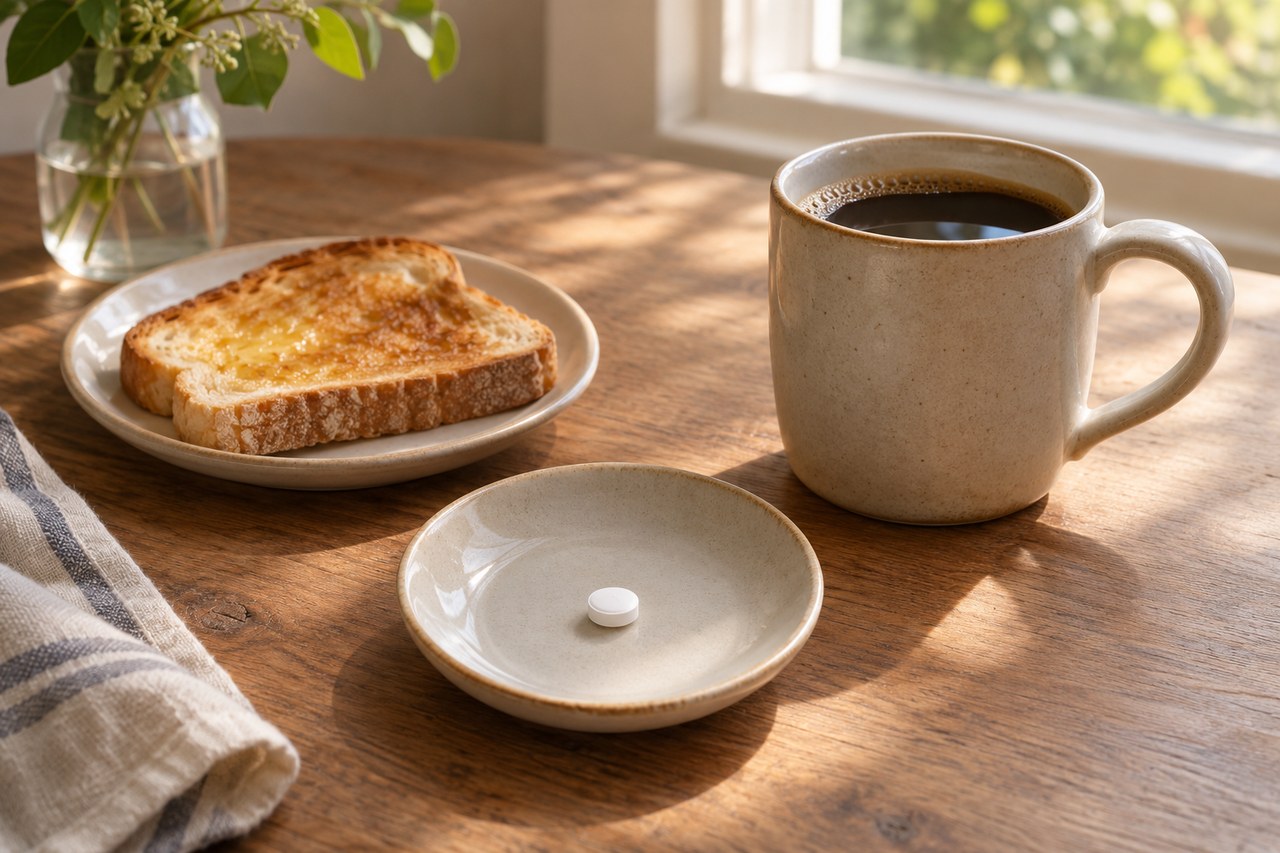
If you've ever taken the existing GLP-1 tablet, you know the ritual. Empty stomach, a small sip of water, then a wait before breakfast — every single morning. Miss the routine and the drug may not do its job. For plenty of people, that ritual is the reason they're on an injection instead.
So a GLP-1 you can swallow with your coffee and toast is a genuinely interesting idea. That's the pitch for orforglipron, a new kind of GLP-1 drug — a small molecule rather than a peptide — designed to be taken once a day with no food or water restrictions. Two large trials published this year tell us what it does. They also tell us what it costs.
What the evidence shows
Against the existing tablet. The ACHIEVE-3 trial enrolled 1,698 adults with type 2 diabetes whose blood sugar wasn't controlled on metformin, at 131 centres in Argentina, China, Japan, Mexico and the USA (Rosenstock et al., The Lancet, 2026). For 52 weeks they took either orforglipron (12 mg or 36 mg) or oral semaglutide — the tablet with the empty-stomach rules — at 7 mg or 14 mg. The trial was open-label, meaning people knew which tablet they were taking, and it was funded by Eli Lilly, which makes orforglipron.
From an average starting HbA1c of 8.3% (HbA1c is the three-month blood sugar average), the orforglipron groups dropped by 1.71 and 1.91 percentage points; the semaglutide groups by 1.23 and 1.47. Orforglipron was designed to prove it was "no worse" than the existing tablet. It did better than that: even the lower dose beat the higher dose of semaglutide.
Now the other side of the ledger. Stomach and gut side effects hit 58-59% of people on orforglipron against 37-45% on semaglutide. Around 9-10% of people on orforglipron stopped treatment because of side effects, roughly double the 4-5% on semaglutide. Resting pulse rose more too: by about 4-5 beats a minute, versus 1-1.5. Four people died during the trial, two in each drug's groups.
The heart-safety test. Any new diabetes drug has to show it doesn't harm the heart. ACHIEVE-4 did that in 2,749 adults with type 2 diabetes who all already had heart or kidney disease, across 317 sites in 16 countries (Klein et al., The Lancet, 2026). People took either orforglipron or a daily insulin injection (glargine) for a median of two years. Serious heart events — cardiovascular death, heart attack, stroke, or a hospital admission for unstable angina — happened in 4.2% of the orforglipron group and 5.0% of the insulin group. That counts as "non-inferior": the tablet is at least as safe for the heart as insulin. It was also much kinder on blood sugar lows: clinically significant hypoglycaemia in 6.8% versus 19.2%. Gut side effects, again, were the main reason people stopped. Also open-label, also funded by Eli Lilly.
For weight, without diabetes. A 2025 trial in 3,127 adults with obesity but no diabetes found that 72 weeks of orforglipron reduced body weight by 7.5% to 11.2% depending on dose, against 2.1% with placebo (Wharton et al., NEJM, 2025). Roughly 5-10% of people stopped because of side effects, versus 2.7% on placebo. Again, Lilly-funded.
What's still uncertain
"Safe for the heart" isn't "protects the heart". ACHIEVE-4 was built to rule out harm, and insulin is a neutral comparator — it doesn't protect the heart itself. Some injectable GLP-1 drugs have shown they reduce heart attacks and strokes. Orforglipron hasn't been tested against one of those yet.
Open-label trials. In both ACHIEVE trials, people knew what they were taking. That doesn't change an HbA1c reading much, but it can colour how side effects get reported — in either direction.
Two years is the longest look we have. The pulse-rate rise is small, but nobody knows what a few extra beats a minute mean over a decade.
It's a middle-weight drug, not a heavyweight. In a 2026 BMJ analysis pooling 262 trials, orforglipron produced about 9.9% weight loss at one year — real, but less than the 14.9% seen with the injection tirzepatide — and it had one of the highest rates of stopping due to side effects (Nong et al., BMJ, 2026). The convenience is the selling point. The power isn't.
What you can do
If you're on the existing GLP-1 tablet and the empty-stomach routine keeps slipping, don't quietly skip doses — tell your doctor it's a struggle. That's useful information, and there may be options now or soon. The question to bring: "Would a tablet with no food rules suit me, and what would I be trading for it?" Whether and when orforglipron reaches pharmacies depends on regulators in each country, so your doctor will know what's actually available where you live.
The jab-versus-tablet choice used to be about effectiveness. Soon it may mostly be about which trade-offs you can live with — and that's a conversation worth having properly, not at the pharmacy counter.
Curiosity first.
— Dr. Brugal
Related on Dr. Brugal
For the wider picture of what's new in diabetes care: The new diabetes treatments — what is real in 2026, and what is coming. · Managing diabetes every day: what the evidence actually says matters. · Fasting with type 2 diabetes: can it work as well as a tablet?
References
All studies retrieved via PubMed.
- Rosenstock J, Yabe D, Cox D, et al. Efficacy and safety of once-daily oral orforglipron compared with oral semaglutide in adults with type 2 diabetes (ACHIEVE-3): a multinational, multicentre, non-inferiority, open-label, randomised, phase 3 trial. The Lancet. 2026;407(10534):1147-1160. Open-label randomised trial, 1,698 people with type 2 diabetes, 52 weeks. doi:10.1016/S0140-6736(26)00202-3 (PMID 41765029)
- Klein KR, Wysham C, Tuttle KR, et al. Cardiovascular safety of orforglipron versus insulin glargine in adults with type 2 diabetes at increased cardiovascular risk (ACHIEVE-4): a phase 3, event-driven, randomised, open-label, non-inferiority, active comparator trial. The Lancet. 2026;408(10564):1557-1570. Open-label randomised trial, 2,749 people with type 2 diabetes and heart or kidney disease, median 2 years. doi:10.1016/S0140-6736(26)01865-9 (PMID 42815506)
- Wharton S, Aronne LJ, Stefanski A, et al. Orforglipron, an Oral Small-Molecule GLP-1 Receptor Agonist for Obesity Treatment. New England Journal of Medicine. 2025;393(18):1796-1806. Double-blind randomised trial, 3,127 people with obesity and no diabetes, 72 weeks. doi:10.1056/NEJMoa2511774 (PMID 40960239)
- Nong K, Shi Q, Xie X, et al. Comparative effects of drugs for adults with overweight or obesity: systematic review and network meta-analysis. BMJ. 2026;394:e372161. Network meta-analysis of 262 randomised trials, 99,791 people with overweight or obesity. doi:10.1136/bmj-2026-372161 (PMID 42419792)
Awareness content — not medical advice. Always talk to your doctor or pharmacist before making changes.