There is a fairly quiet number sitting on most home blood pressure monitors that nobody quite knows what to do with.
You take a reading in the morning. The top number is 138. The bottom is 84. You are not in crisis. You have not been told you need a tablet, or you are on one and the number is hovering above where your doctor would like it. You know, vaguely, that you should "eat better" — which is the kind of advice that means everything and therefore nothing.
Here is the more useful version. There are three small shifts you can make on your plate, and the recent evidence on each is actually surprisingly tight. Done together, for a few weeks, they move blood pressure in a measurable way — somewhere in the region of 7 to 11 mmHg on the systolic number in people with hypertension. That is in the same magnitude as a single low-dose starting medication. It is not a replacement for one — but it is not nothing, either.
This is how those three shifts actually work.
Why the plate moves the needle
The most-studied dietary pattern for blood pressure is called DASH — short for Dietary Approaches to Stop Hypertension. It is not a diet you go on and come off. It is a structure: more fruit and vegetables, more whole grains, more pulses and nuts, less red and processed meat, less added sugar, and crucially, less salt.
The most recent systematic review of randomised trials, published in 2025, found that following DASH on its own dropped systolic blood pressure by between 1 and 5 mmHg. That sounds small. The interesting number comes when DASH is combined with cutting salt: systolic blood pressure falls by around 7 mmHg in people without hypertension and 11.5 mmHg in those with it. The two interventions are not additive in the way you might expect — they multiply each other.
That is the headline. Underneath it sit three levers you can pull, in any order. Pulling all three is the version that moves the number. Pulling one is still worth doing.
Lever one: less salt — but more honestly than that
"Eat less salt" is the advice everyone has already heard and most people have already ignored. The reason is that the salt that matters is almost never the salt you put on your food. It is the salt already in it — bread, supermarket sauces, ready meals, processed meats, the cracker you eat without thinking. Roughly three quarters of the salt the average UK adult eats was added before the food reached the plate.
The number that matters: cutting 3 g of salt a day lowers systolic blood pressure by about 3.5 mmHg, and diastolic by about 2 mmHg. That figure holds in adults already taking blood pressure medication — a 2024 review of 35 trials confirmed it. UK adults eat around 8.4 g of salt per day on average. The official limit is 6 g. The realistic target is to close that 2 to 3 g gap.
You do not do it by removing the salt cellar from the table. You do it by reading two or three labels — your usual bread, your usual sauce, your usual ready meal — and swapping one of them for a lower-salt version. That is it. One swap, kept consistently, is worth more than a heroic week of cooking everything from scratch and then giving up.
Lever two: more potassium — the missing half of the equation
Salt reduction is the lever everyone knows about. Potassium is the one almost nobody talks about, even though it does roughly half of the work.
The World Health Organization, the European Society of Cardiology and the American Heart Association all currently recommend adults aim for at least 3.5 g of potassium a day from food. The average UK adult eats around 3 g. The gap is small, but it is the gap that matters: every dose-response analysis since 2020 has shown that adding potassium-rich foods lowers blood pressure independently of cutting salt — and the effect is strongest in people who already have hypertension.
Practically: a single baked potato eaten with the skin gives you around 900 mg. Half a cup of cooked white beans gives you around 600 mg. A cup of cooked spinach gives you around 840 mg. A banana — the food everyone associates with potassium — gives you a fairly modest 360 mg. Bananas are not the answer; the rest of the supermarket is.
One quiet shortcut endorsed by the 2024 European cardiology guidelines and the 2025 American ones: potassium-based salt substitutes. These are salt blends that replace some of the sodium chloride with potassium chloride. They taste salty. They move two levers at once. They are not appropriate for everyone — people with kidney disease, or on potassium-sparing diuretics, must check with their doctor first — but for most adults they are an unusually low-effort intervention.
Lever three: the plants that talk to your blood vessels
This is the lever that surprises people, because the evidence is more specific than "eat more vegetables."
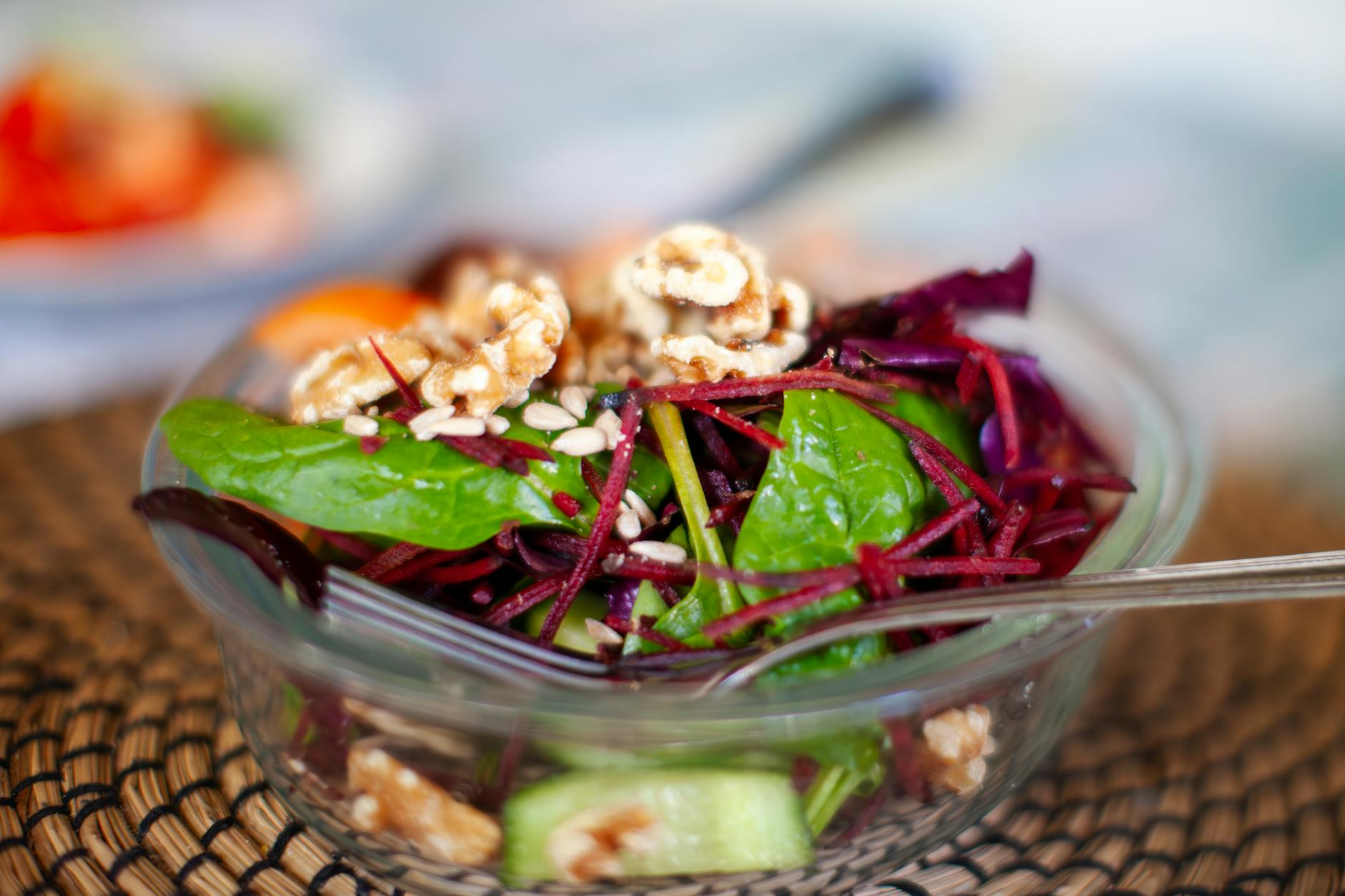
Certain plants are unusually rich in dietary nitrate. Your body converts that nitrate into nitric oxide, which is the molecule that tells your blood vessel walls to relax and widen. The result is a small, real drop in blood pressure — most studied in beetroot, but the same pathway is fed by spinach, rocket, lettuce, celery and chard.
The 2024 meta-analysis of trials in people with hypertension found that beetroot juice — around 250 ml a day, which is one small glass — lowered clinical systolic blood pressure by about 5 mmHg, sustained for up to three months. A 2025 crossover trial found even larger drops in some people. Whole beetroot and the leafy greens above feed the same pathway, more slowly and less concentrated, but daily.
There is a second plant pathway worth knowing about: flavanols from cocoa. The same nitric oxide mechanism. The 2022 Cochrane-style review found that dark chocolate eaten consistently for at least two weeks dropped systolic blood pressure by around 4 mmHg — but only at doses that delivered around 900 mg of flavanols a day, which means 20 to 30 g of dark chocolate at 70% cocoa or higher. Milk chocolate does not count. Hot chocolate from a tin does not count. The plain dark stuff, in a small square, does.
The one to start with this week
If all three at once feels like too much, here is the version that gives you the highest return for the lowest effort.
Pick one product you eat almost daily that is high in salt — your usual loaf of bread, your usual pasta sauce, the brand of soup you keep in the cupboard. Read the label. Swap it for a version with at least a third less salt. Keep the swap for two weeks.
At the same time, add one potassium-rich item to one meal a day: a baked potato instead of chips, a side of beans with your dinner, a handful of spinach folded into eggs. One addition. Daily.
Two weeks is the minimum window in which the BP response becomes visible. If you have a home blood pressure monitor, take a reading in the morning and one in the evening, sitting quietly for five minutes first. Write them down. The first three readings of any given week are noise. The pattern across two weeks is signal.
You will not know if it is working unless you watch
This is the part of the advice that rarely makes it onto the leaflet. The reason most lifestyle changes feel pointless is that nobody ever shows you the number moving. You eat differently for a fortnight, the abstract benefit is theoretical, and one quiet evening you eat the crisps anyway.
The fix is to make the number visible. A cheap home monitor, a notebook, a free app — anything you will actually open. We made a small one ourselves for exactly this — BPaper — but the brand of monitor and the app are less important than the habit. Morning, evening, write it down. After two weeks you have a chart. The chart is what tells you whether the swap was worth keeping.
The fork is doing something. You just have to be able to see it.
Awareness content, not medical advice. Always consult your doctor or pharmacist before making changes — especially if you are taking blood pressure medication, have kidney disease, or are considering potassium-based salt substitutes.
Curiosity first.